TrakSYS.
Parsec has been building TrakSYS since 1987 and reports it running in thousands of factories across more than 100 countries. We use it when parts of a process fit no packaged module, and when there are enough sites and systems that governing the rollout is itself a piece of engineering. It's the platform under our longest engagement: 25+ sites at Corticeira Amorim on one template, first live in 2015 and still running. It's also why Parsec lists us as a Strategic Partner.
What you get for the extra weight.
TrakSYS asks more of us than a packaged module set does. We'll spend longer in design, we'll configure more, and we'll need someone whose job it is to own the configuration after go-live. But the level of adaptability to your processes pays that back.
One template across many sites
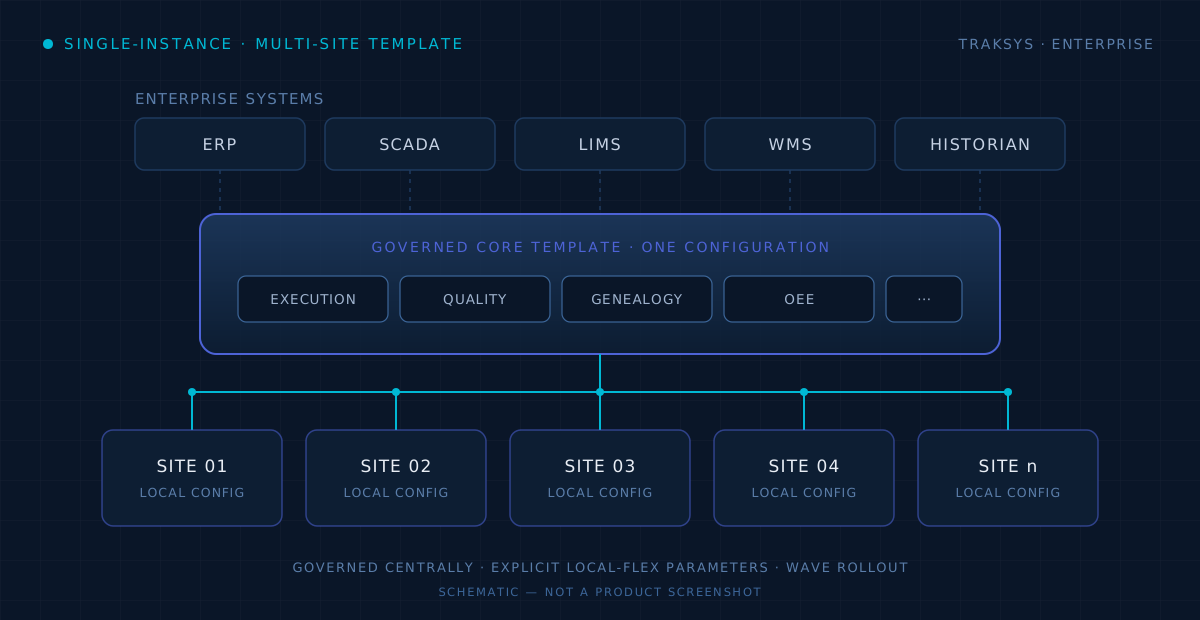
A single governed configuration rolled out in waves. Sites inherit the core and configure inside explicit parameters. They cannot fork it, which is what keeps 25 plants from becoming 25 systems.
Integration that goes past the ERP
ERP, SCADA, LIMS, WMS, CMMS and historians, in both directions. Native OPC UA, MQTT with Sparkplug B, REST and SQL, plus direct support for Rockwell, Siemens, OSIsoft PI and AVEVA.
Configuration first, code where needed
Most of a solution is built in code-free configuration tools. When a requirement genuinely does not fit, there is scripting underneath rather than a change request to the vendor.
Records a regulator will accept
Audit trails, electronic signatures and version control built in from the start, rather than bolted on for the one customer who asked.
One template. Many sites. Governed.
Multi-site MES dies of drift. Site four needs one small exception, gets it, and two years later nobody can upgrade anything. The pattern below is how we stop that at our clients, where multiple plants inherit one core configuration and can configure only inside parameters we've set.
Which of these you turn on in wave one.
Parsec ships TrakSYS as functional solution areas. You almost never need all of them on day one. During Discovery we quantify your losses by category (unplanned downtime, scrap, changeover, speed) and sequence the build so the biggest category gets addressed in wave one.
Production
Jobs synchronised with ERP or created in the platform. Quantities, schedules and asset assignments move against real demand and real capacity.
Performance & OEE
OEE, yield and productivity from counts, scrap and equipment states captured at source. Nothing back-filled from a spreadsheet at the end of the shift.
Quality
SPC, scrap and defect tracking, deviation analysis and electronic records, tied to the production event that caused them.
Traceability
Genealogy from raw material to finished goods — lot movement, transformations, component usage — via 1D and 2D barcode, direct part marking or RFID.
Batch
Recipe management, SOP enforcement and batch records aligned to ISA-88, for process manufacturers who run formulations rather than part numbers.
Maintenance
Plan, schedule and monitor maintenance against equipment condition and run hours rather than the calendar alone.
Inventory
Material tracking and WIP, reconciling live production against ERP so the stock figure and the shop floor agree.
Compliance
The audit trail, e-signature and version-control layer underneath the rest — see the section below on what that does and does not mean.
If an auditor is going to read it.
Parsec built TrakSYS for regulated industries from the start rather than retrofitting compliance later, and the difference shows up in how much argument you have with your quality function.
Pharma & medical device
Used in programmes governed by 21 CFR Part 11 and Part 820, EU Annex 11, GMP and ISO 13485.
Food & beverage
Lot genealogy and control-plan execution under FSMA, SQF, BRC and ISO 22000 regimes.
The controls themselves
Audit trails on every change, electronic signatures at the point of action, and version control over the configuration itself.
ISA-88 recipes and SOPs
Recipes managed and SOPs enforced in the execution path, so the record is generated by the work rather than written up afterwards.
No MES is "21 CFR Part 11 certified", and Parsec says so itself. There is no certifying body. The platform provides the controls; validating your specific configuration against your own processes is your responsibility, and it is a real workstream with a real cost. Anyone who tells you their software arrives pre-validated is selling you a surprise for later.
What changed in the current release.
Parsec released TrakSYS 14 in February 2026. Two of the additions matter for the kind of programmes we run, and one is mostly interesting to your IT function.
Solution Studio
Develop, version and promote a standardised solution across environments while each site keeps its own configuration. This replaces copying configuration between systems by hand, which is exactly where multi-site templates used to go wrong.
IQ Assistant
Ask questions of production data in plain language — investigate a performance drop, generate a chart, summarise what happened — without building a report first. The first AI capability embedded in the product itself.
TrakSYS Cloud
A SaaS control plane for the environments themselves: licences, system health and backups in one place, rather than tracked per site.
Sparkplug B over MQTT
Native support for structured IIoT payloads, which makes brownfield connectivity a configuration job more often than an integration project.
Containerised services
Services deployable under Docker and Kubernetes, which usually decides whether your platform team is willing to host it.
Open APIs
REST APIs and SDKs over real-time and historical data. Whatever you build on top of the MES later, the data is reachable.
Release contents as published by Parsec. Which version you land on, and which of these you actually get, is confirmed against your target release during Design.
Industries Parsec sells into.
Automotive, chemicals, food and beverage, life sciences and packaged goods. Our own delivery has concentrated in cork and forest products, food and dairy, packaging, automotive and construction-as-manufacturing — the sector pages go into what that means in each.
What Parsec's top partner level requires.
Parsec's partner programme runs to four levels. Strategic is the top one, and it is not granted on revenue. It requires company certification, certified TrakSYS Engineers and Architects on staff, documented delivery practice, and a contracted number of customer-referenced implementations that actually went live.
We hold it. The evidence behind it is a single-instance template running across 25+ sites at Corticeira Amorim, the world's largest cork producer, first live in 2015 and still being extended.
What buyers ask us about TrakSYS.
When is TrakSYS the wrong choice?
When you run one plant, your process fits packaged modules, and nobody internally is going to own a configuration after go-live. TrakSYS rewards an organisation that has real design decisions to make. If yours doesn't, AquiWeb gets you to measured OEE faster and costs less to keep. We'll say so in Discovery, before you've spent anything.
What does "Parsec Strategic Partner" actually mean?
Parsec's partner programme has four levels and Strategic is the top one. It isn't granted on revenue. It requires company certification, certified TrakSYS Engineers and Architects on staff, documented delivery practice, and a contracted number of customer-referenced implementations that went live. We hold it, and the evidence is a single-instance template running across 25+ sites at Corticeira Amorim since 2015.
Is TrakSYS 21 CFR Part 11 certified?
No MES is, and Parsec says so itself. There's no certifying body. TrakSYS provides the controls: audit trails, electronic signatures, and version control over the configuration itself. Validating your specific configuration against your own processes is your workstream, with its own budget and timeline. Anyone selling you pre-validated software is selling you a surprise for later.
Will it talk to our PLCs and our SAP?
Both, in both directions. On the OT side: native OPC UA, MQTT with Sparkplug B, REST and SQL, plus direct support for Rockwell, Siemens, OSIsoft PI and AVEVA. On the IT side: ERP, LIMS, WMS, CMMS and historians. Protocols are the easy part. What takes time is agreeing master data and deciding what a production order means on both sides. We scope that explicitly, and your ERP partner owns their half of it.
How do you stop a multi-site rollout turning into separate systems?
Sites inherit one core configuration and can configure only inside parameters the template sets. They can't fork it. TrakSYS 14 added Solution Studio, which versions and promotes a standardised solution across environments while each site keeps its own configuration. That replaces hand-copying configuration between systems, which is where multi-site templates used to go wrong. Designing that governance is most of what we're paid for.
Do we need our own MES team to run it?
Someone has to own the configuration. Usually that's a small internal MES team, or us on retainer. At Corticeira Amorim the template has been extended continuously since 2015, and that only works because somebody's name was on it from the first site.