We implement two MES platforms.
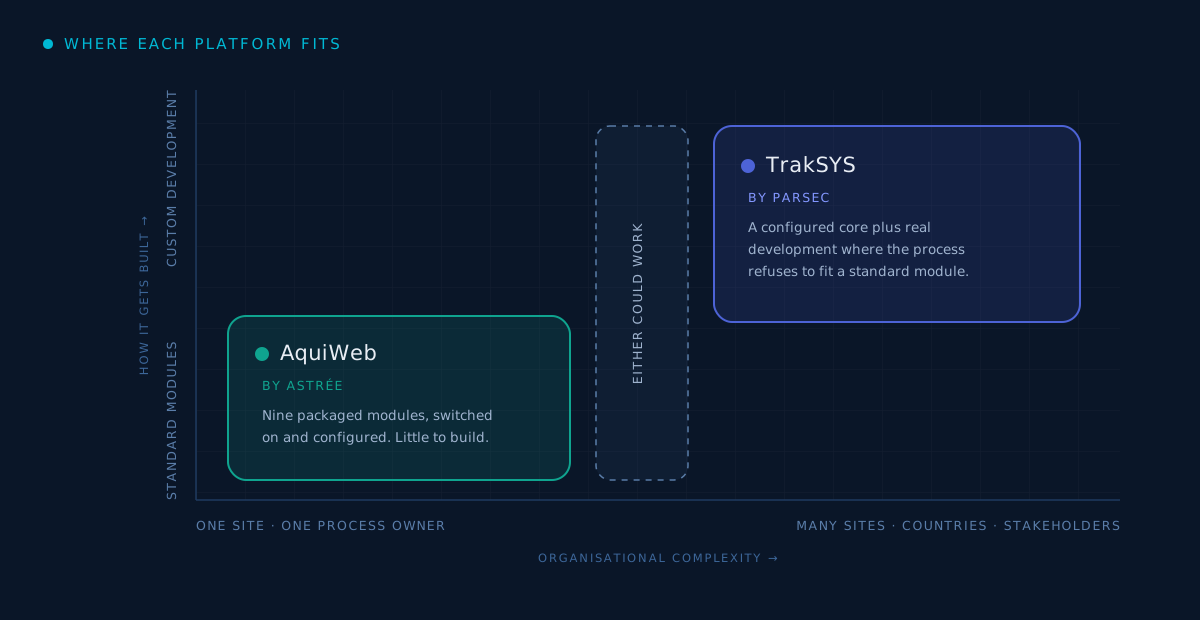
TrakSYS from Parsec and AquiWeb from Astrée. Which one you should run comes down to two things: how complicated your organisation is, and how much of the solution has to be built rather than switched on. We recommend the best solution for your business. What you are actually buying from us is the architecture, the integration work, and getting operators to use the thing.
TrakSYS
We reach for TrakSYS when a packaged module can't hold the process, and when there are enough sites and systems that governing the rollout is its own piece of engineering. Parsec has been building it since 1987. It runs our longest engagement: 25+ sites at Corticeira Amorim on one template, first site live in 2015.
What TrakSYS doesAquiWeb
Nine packaged modules cover OEE, quality, traceability, maintenance, scheduling, documentation, guided work, stock and energy. You switch on the ones you need and configure them. Astrée has built it since 2011 and reports it on 400+ industrial sites across 18 countries. There's much less to construct, and much less you can bend.
What AquiWeb doesHow different are they, really?
Two rows in the table below decide most cases: how the solution gets built, and how complicated the organisation around it is. Everything else is context that shifts a borderline call.
| Selection dimension | TrakSYS by Parsec | AquiWeb by Astrée |
|---|---|---|
| Vendor | Parsec Automation, United States. Building TrakSYS since 1987. | Astrée Software, France. Founded 2011, part of the 4CAD Group since February 2024. |
| How it gets built | A configured core plus real development where the process needs it. Code-free configuration tools with scripting underneath when a requirement genuinely calls for it. | Nine packaged modules, switched on and configured. Little to construct, and the shape of the modules sets the shape of the solution. |
| Organisational scope | Many sites, countries and business units on a single governed template, rolled out in waves. | One site, or a handful with similar processes. |
| Where it is strongest | Complex, heavily integrated operations where several functions argue over the same data. | Getting a plant off paper and onto measured OEE quickly, with quality and traceability behind it. |
| Architecture | Microsoft .NET, HTML and JavaScript. On-premises, cloud or hybrid, with containerised services. | 100% web. Nothing installed on the client; on-premises or AWS-hosted. |
| Integration | ERP, SCADA, LIMS, WMS, CMMS and historians, over OPC UA, MQTT with Sparkplug B, REST and SQL. | ERP, plus shop-floor collection over OPC UA, Ethernet I/O, IIoT modules and AS-i bus. |
| Regulated industries | Built with regulated manufacturing in mind: audit trails, electronic signatures and version control for 21 CFR Part 11, EU Annex 11 and ISO 13485 programmes, with ISA-88 recipe and SOP management. | Quality, traceability and document control modules with per-step operator validation. Astrée does not claim an equivalent regulated-industry toolset. |
| Who maintains it after go-live | Usually a small internal MES team, or us on retainer. Deep configurability means someone has to own it. | Often the plant's own continuous-improvement lead, with vendor support behind them. |
| Vendor-reported reach | Parsec reports TrakSYS in thousands of factories across more than 100 countries. | Astrée reports AquiWeb on 400+ industrial sites, used daily by more than 21,000 people across 18 countries. |
Reach and capability figures are the vendors' own, and describe the products rather than anything we have delivered.
If you have to defend the choice to a board, our MES Buyer's Guide & Vendor Selection Framework is a scoring model written from the buyer's side of the table.
Answer twelve questions and we'll tell you which one to shortlist.
These are the questions we work through in a Discovery call, in roughly the order we ask them. Nothing is stored unless you ask us to send you the summary at the end.
Questions buyers ask us before they choose.
Should I pick TrakSYS or AquiWeb?
Two things decide it. If your process fits packaged modules and you're running one plant or a few that work the same way, AquiWeb gets you to a measured OEE number faster and costs less to keep running. If parts of the process need building, or you're governing a rollout across many sites and business units, TrakSYS is the one that holds. The twelve-question selector on this page gives you a directional answer in about five minutes. A Discovery call gives you one you can defend to a board.
Are you independent, or do you push whichever platform you're certified in?
We're certified in both. We're a Parsec Strategic Partner, the top of Parsec's four-level programme, which requires company certification, certified TrakSYS Engineers and Architects on staff, and a contracted number of referenced implementations that actually went live. We also hold a delivery partnership with Astrée for AquiWeb. You license from Parsec or Astrée directly, so the licence revenue isn't ours either way. Carrying two certifications is expensive, and it's what lets us say no to one of them.
Can we start on AquiWeb and move to TrakSYS later?
You can, and you'd pay for the same ground twice. Migration means re-modelling equipment, re-mapping the ERP interface and retraining every operator. If you already know a second wave of sites is coming, or that one plant runs something no module handles, decide for TrakSYS now. If you genuinely have one plant and a paper problem, AquiWeb is the right answer and the hypothetical isn't worth the premium.
Which one works for regulated manufacturing?
TrakSYS. Parsec built audit trails, electronic signatures and version control over the configuration itself into the base product, and it's used in programmes governed by 21 CFR Part 11 and Part 820, EU Annex 11, GMP and ISO 13485, with ISA-88 recipe and SOP management. AquiWeb has quality, traceability and document control with per-step operator validation, which covers a lot of food and beverage work, but Astrée doesn't claim an equivalent regulated-industry toolset. One thing to know either way: no MES is “21 CFR Part 11 certified”, because there's no certifying body. Validating your configuration is a real workstream with a real budget.
Who maintains the system after go-live?
On AquiWeb it's usually the plant's own continuous-improvement lead, with Astrée support behind them and Astrée's MyAquiweb academy to train on. On TrakSYS it's usually a small internal MES team, or us on retainer. Deep configurability means somebody has to own the configuration. Name that person before go-live.
Do you implement any other MES platforms?
No. We've delivered 42 sites on these two, and staying on two is why our engineers know them at the depth a hard integration needs. If you've already bought a third platform, we'll tell you straight whether we can help.